- apps
- electronics
- visualization
Circuit Lab
Five interactive instruments for electrical and electronics engineering - RLC and phasors, Bode filters, a Smith chart, diode and MOSFET curves, and buck and boost converters
datasheet // electronics-lab
- images
- 0
- videos
- 0
- formats
- none (text only)
- text
- 283 words · 2 min read
- studio
- /studio (gallery)
On this page0%
An interactive companion to the electronics learning pages on this site. Move a slider and watch the textbook formula’s answer move, with the key numbers read out under each plot. Open the lab or open it full screen. The lab, the ten learning pages’ notes and the figure code live in their own repository and site: openelectronics (source).
The five instruments
- RLC and phasors. A series RLC circuit driven by a 1 V source: current against frequency, resonance f₀ = 1/(2π√LC), quality factor Q, bandwidth, and a phasor diagram drawn tip to tail.
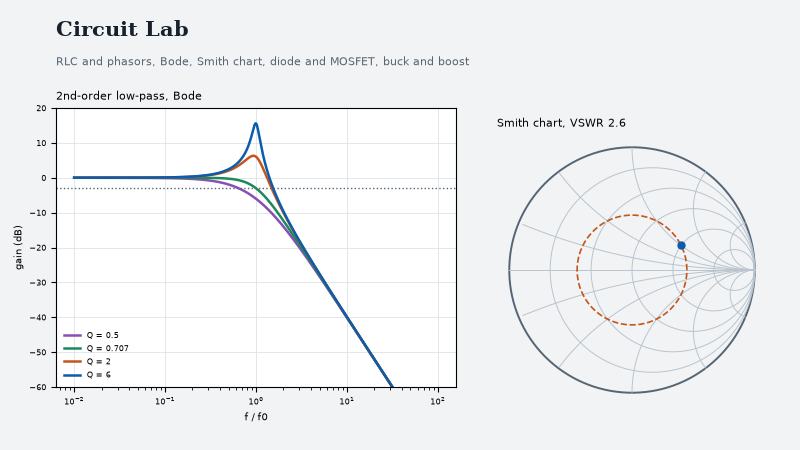
- Bode plots. First- and second-order low-pass, high-pass and band-pass filters: gain, phase, the −3 dB point and the effect of Q.
- Smith chart. Load impedance on a lossless line: reflection coefficient, VSWR, return loss, mismatch loss, and the impedance seen after moving a fraction of a wavelength toward the generator.
- Diode and MOSFET. A diode with a series resistor and its load line, and square-law MOSFET output curves with the triode and saturation regions and the transconductance.
- Buck and boost converters. Output voltage, inductor ripple, output ripple, critical inductance and a three-period inductor-current waveform, with a warning when the converter leaves continuous conduction.
Related learning pages
Power electronics converters, RF, antennas and microwaves, MOSFET and CMOS scaling, Sensors, MEMS and control.
Models and limits
- Lumped RLC, Shockley diode (I_S = 1 pA, 300 K), square-law MOSFET with channel-length modulation (no subthreshold current), lossless transmission line, ideal switches and components in the converter.
- Intended for learning and for checking hand calculations, not for design sign-off.
- The formulas were checked against independent Python calculations (resonance, Smith chart rotation, diode operating point, converter ripple) and the Bode peak against the exact second-order result.