- apps
- visualization
- education
Periodic Table Builder
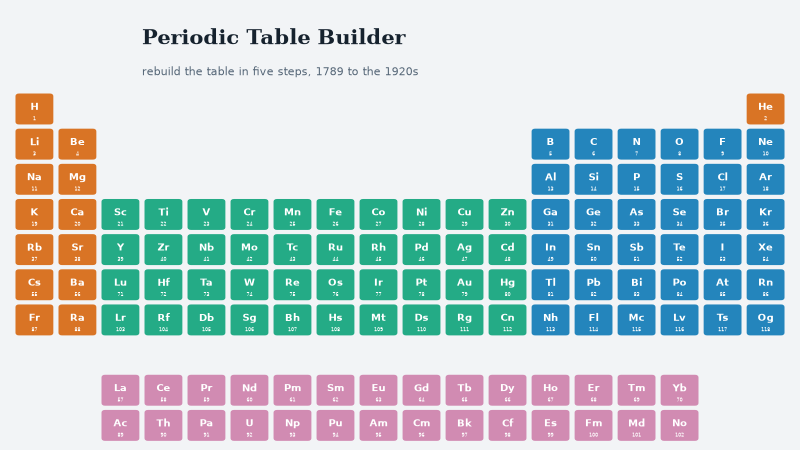
An interactive app that rebuilds the periodic table in five historical steps, from Lavoisier's 33 simple substances to quantum shells
datasheet // periodic-table-builder
- images
- 0
- videos
- 0
- formats
- none (text only)
- text
- 277 words · 2 min read
- studio
- /studio (gallery)
On this page0%
An interactive learning app, built with a short course on how the periodic table was made. Instead of memorizing the table, the student repeats the steps that produced it. Open the app or open it full screen. The app, the course notes and the code live in their own repository and site: openperiodictable (source).
The five steps
- Elements (1789). Sort Lavoisier’s 33 “simple substances” into elements, compounds and things that are not matter, and see why he weighed everything in a closed vessel.
- Weight order (1864). Put the lightest elements in order of atomic weight and slide the row length until each chemical family lines up in a column. Newlands found the rhythm at seven.
- Gaps (1869). Predict the missing elements gallium and germanium by averaging their neighbours, then compare with what was found.
- Atomic number (1913). Enter an X-ray energy and read off the atomic number with Moseley’s law. Three pairs that atomic weight puts in the wrong order come out right.
- Shells (1920s). Add electrons one at a time into the lowest free subshell and watch the rows of 2, 8, 8, 18, 18, 32, 32 appear.
Sources and limits
- Lavoisier’s table: Traité élémentaire de chimie (1789). K-alpha line energies: X-ray Data Booklet, Lawrence Berkeley National Laboratory, Table 1-2. Atomic weights are rounded IUPAC abridged values.
- Years and discoverers shown in the app are approximate. They come from general knowledge and should be checked against a history of the periodic table before they are quoted.
- Stage 5 uses the simple filling order and marks the measured exceptions (for example chromium and copper); the exceptions list was written from general knowledge and should also be checked.