- sciml
- combustion
Symbolic Regression for Universal Rate Rules
Using symbolic regression to discover interpretable rate rules for unimolecular decomposition reactions
datasheet // pysr-rate-rules
- images
- 1
- videos
- 0
- formats
- png
- text
- 272 words · 2 min read
- studio
- /solver?tab=sr&preset=0
- source
- previous site
- topics
-
- method ×1
On this page0%
Problem
Unimolecular decomposition rate constants for NH3–hydrocarbon fuel chemistry are scattered across decades of literature, each measured under different conditions and with different uncertainty. Can a compact, interpretable formula — rather than a lookup table — predict a reaction’s rate parameters from physically meaningful features?
Approach
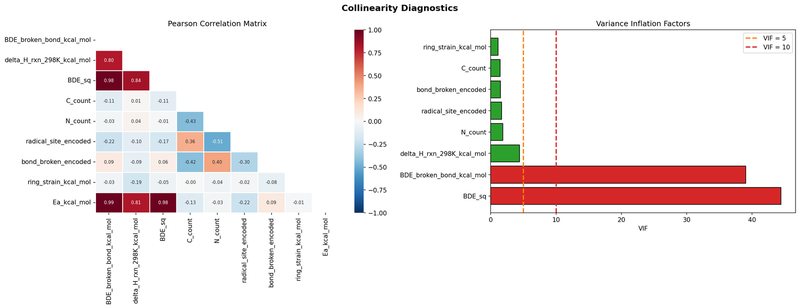
A curated, provenance-tracked database of 325 high-pressure-limit unimolecular reactions (23 nitrogen-containing), each carrying its literature source, DOI, and an uncertainty factor. Symbolic regression (PySR) is run against physics-informed, low-collinearity feature sets: Evans–Polanyi-motivated features (bond-dissociation energy, reaction enthalpy, a Marcus quadratic term) for the activation energy, and reaction-path degeneracy/symmetry features for the pre-exponential factor — comparing a plain-MSE model against one weighted by each reaction’s literature uncertainty.
Validation
Two checks beyond a standard train/test split: does the discovered formula rediscover the known Evans–Polanyi linear free-energy relation from data alone, and does it transfer across an entirely held-out reaction class (leave-one-class-out), not just across held-out samples of classes it has already seen.
Results
Exploratory, unpublished work. The symbolic regression front shows the expected shape — the discovered low-complexity term closely tracks the Evans–Polanyi form, and the model generalizes to the held-out class rather than only interpolating within seen chemistry — but no manuscript results are quoted here pending write-up.
My contribution
Developed by me: the database curation and provenance pipeline, the physics-informed feature engineering, the uncertainty-weighted model formulation, and both validation protocols. PySR itself (Miles Cranmer) is the external symbolic-regression engine.
Where this is going
A rate rule that’s a formula, not a black box — one that can be checked against known physical chemistry and used with some confidence outside the exact reactions it was trained on.
Gallery
How to recreate this plot
Watch
Steps
- Open the controls panel
- Pick example 1: A calibration line by least squares
- Raise the polynomial degree to 2
- Raise the polynomial degree to 4
- Lower it back to 1
Code and PDF notes
Free of cost. I approve each request and reply by email.
To request the files, email me at krunalpanchal1995 [at] gmail [dot] com and mention the item id. project-pysr-rate-rules