- experimental
- combustion
Steam-Catalytic Downdraft Gasification
M.Tech thesis — steam and catalyst effects on lignite gasification in a pilot-scale downdraft gasifier
datasheet // gasification
- images
- 9
- videos
- 0
- formats
- png
- text
- 475 words · 3 min read
- studio
- /molecules?preset=12
- source
- previous site
- topics
-
- headline ×3
- rigor ×3
- experiment ×3
On this page0%
Problem
Steam gasification of low-rank lignite coal, with and without a catalyst, was studied to understand how steam-to-biomass ratio (SBR) and a magnesium-carbonate catalyst affect syngas quality — but the resulting hydrogen yield behaved in a way no simple model predicted.
Approach
A pilot-scale downdraft fixed-bed gasifier (525 mm ID, 2.165 m tall, mild steel) was instrumented with four K-type thermocouples across the drying/pyrolysis/combustion/reduction zones and a gas chromatograph for H2, CO, CO2, CH4, N2. Fourteen runs spanned seven steam-to-biomass ratios (0–0.47 kg/kg) with and without a 7 wt% MgCO3 catalyst.
Results
Published, Upadhyay et al. (2020), Upadhyay et al. (2019), Sakhiya et al. (2019), Upadhyay et al. (2018).
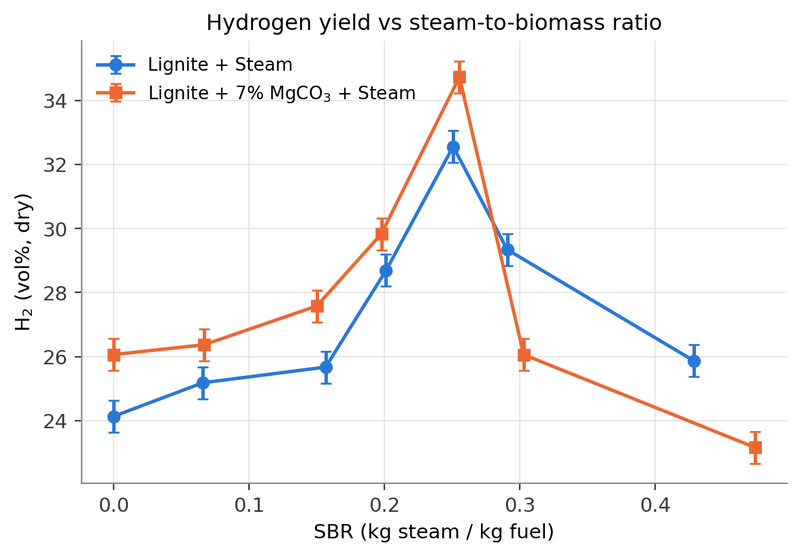
The catalyst raised hydrogen yield from 24.1–32.6% to 23.2–34.7%, cold-gas efficiency from 62.2–75.2% to 68.1–86.9%, and lower heating value from 4.48–5.19 to 4.67–6.65 MJ/Nm3. The headline finding was a non-monotonic hydrogen response: with the catalyst, H2 climbed to a 34.7% peak around SBR ≈ 0.26 and then collapsed to 23.2% by SBR ≈ 0.47 — falling below the no-catalyst case — moving in lockstep with cold-gas efficiency and heating value.
A later re-analysis (2026) found the mechanism: combustion-zone temperature is itself non-monotonic across the same SBR sweep, and hydrogen yield tracks that temperature (Pearson r = 0.80 pooled, r = 0.96 in the catalytic case) far more closely than it tracks SBR directly (r = 0.10). This re-analysis is ongoing exploratory work, reported here qualitatively; the original 2018 experimental results and their equilibrium-model comparison are the validated, published record.
Validation
Mass-balance closure between 0.920 and 0.995 across all fourteen runs.
My contribution
Experimental design, rig operation, and primary analysis, under the supervision of Prof. D. S. Upadhyay and Prof. R. N. Patel at Nirma University. Awarded the ISTE National Award for Best M.Tech Thesis 2018 (First Prize).
Publications
- Upadhyay, D. S.; Panchal, Krunal R.; Sakhiya, A. K. V.; Patel, R. N. (2020). Air-Steam gasification of lignite in a fixed bed gasifier: Influence of steam to lignite ratio on performance of downdraft gasifier. Energy 211, 118187. doi:10.1016/j.energy.2020.118187
- Upadhyay, D. S.; Sakhiya, A. K.; Panchal, Krunal; Patel, A. H.; Patel, R. N. (2019). Effect of equivalence ratio on the performance of the downdraft gasifier – An experimental and modelling approach. Energy 168, 833–846. doi:10.1016/j.energy.2018.11.133
- Sakhiya, A. K.; Chaturvedi, A.; Barasara, V.; Panchal, Krunal; Upadhyay, D. S.; Patel, R. N. (2019). Elemental and heat loss analysis of different feedstock in downdraft gasifier. Journal of Energy and Environmental Sustainability 7, 10–16. doi:10.47469/jees.2019.v07.100070
- Upadhyay, D. S.; Sakhiya, A. K. V.; Panchal, Krunal R.; Patel, R. N. (2018). Thermodynamic analysis of lignite gasification in the downdraft gasifier. Journal of Energy and Environmental Sustainability 5, 58–64. doi:10.47469/jees.2018.v05.100058
Where this is going
A rare downdraft-gasification dataset where the “obvious” steam-ratio-controls-hydrogen story turns out to be incomplete — and a reminder that a null or reversing trend is often more informative than a monotonic one.