All projects

  • optimization
  • uq
  • combustion

PhD thesis: a fast, robust, kinetics-based optimization framework

IIT Madras doctoral thesis on optimization of combustion kinetic models; Chapter 3 and Chapter 4 figures
30 images · 2 min read

PhD thesis: a fast, robust, kinetics-based optimization framework

datasheet // phd-thesis

images
30
videos
0
formats
png, jpg
text
230 words · 2 min read
topics
  • chapter 3 ×14
  • chapter 4 ×16

Datasheet

  • Title (thesis.tex): Development of a Fast, Robust, and Kinetics based Optimization Framework for Combustion Kinetic Models
  • Author: Krunal Rajeshkumar Panchal, Department of Mechanical Engineering, Indian Institute of Technology Madras
  • Degree: Doctor of Philosophy
  • Guide: Dr. Krithika Narayanaswamy (Associate Professor, Mechanical Engineering)
  • Doctoral committee: Dr. Shamit Bakshi (chairperson, Professor, Mechanical Engineering); Dr. Kameswararao Anupindi (Associate Professor, Mechanical Engineering); Dr. Babu Viswanathan (Professor, Mechanical Engineering); Dr. Preeti Aghalayam (Professor, Chemical Engineering)
  • Thesis submitted October 2025; viva 12 May 2026; degree conferred 16 July 2026

Chapters

  1. Introduction
  2. Literature Review
  3. Enhanced Multi-Stage Optimization Strategy for Combustion Kinetic Models (14 figure files shown here)
  4. A fast uncertainty quantification methodology and sampling technique for joint probability distribution of the Arrhenius rate expression: A case study applied to H2/CO kinetic mechanism (16 figure files shown here; the flow-diagram figure is drawn in TikZ and is not included)
  5. Conclusion
  6. Scope of future research
  7. Appendix A1

Publications listed in the thesis

  • K. R. Panchal, V. Vasudevan, S. Ambikasaran and K. Narayanaswamy (2024). A fast uncertainty quantification methodology and sampling technique for joint probability distribution of the Arrhenius rate expression: a case study applied to H2/CO kinetic mechanism. Combustion Theory and Modelling, 28 (4), 411-440.
  • K. R. Panchal, V. Vasudevan and K. Narayanaswamy (2023). A multi stage kinetic reaction optimization strategy applied to n-heptane combustion mechanism. Oral presentation at the 14th Asia-Pacific Conference on Combustion (ASPACC 2023), Kaohsiung, Taiwan.
Chapter 3. n-heptane: mechanism from the literature compared with the reduced mechanism used in this work Explain Optimization
Chapter 3. First-order sensitivity coefficients, methyl butanoate, low-temperature chemistry (bars at 850 K and 1200 K) Explain Optimization
Chapter 3. First-order sensitivity coefficients, methyl butanoate, high-temperature chemistry (bars at 850 K and 1200 K) Explain Optimization
Chapter 3. First-order sensitivity coefficients, n-heptane, low-temperature chemistry (bars at 900 K and 1200 K) Explain Optimization
Chapter 3. First-order sensitivity coefficients, n-heptane, high-temperature chemistry (bars at 900 K and 1200 K) Explain Optimization
Chapter 3. Methyl butanoate: nominal vs optimized mechanism, high-temperature targets (multi-stage optimization) Explain Optimization
Chapter 3. Methyl butanoate: nominal vs optimized mechanism, low-temperature targets (multi-stage optimization) Explain Optimization
Chapter 3. n-heptane: nominal vs optimized mechanism (multi-stage optimization) Explain Optimization
Chapter 3. Ethyl butanoate ignition delay vs temperature near 3 MPa: 8 measured points, spline mean curve, 95% bootstrap interval Explain Optimization
Chapter 3. Methyl butanoate ignition delay vs temperature near 3 MPa: 7 measured points, PCHIP mean curve, 95% bootstrap interval Explain Optimization
Chapter 3. Methyl butanoate high-temperature targets; mechanism optimized on low-temperature targets with spline-interpolated points Explain Optimization
Chapter 3. Methyl butanoate: nominal vs optimized mechanism against synthetic low-temperature targets (spline interpolation) Explain Optimization
Chapter 3. Number of active parameters for high- and low-temperature targets, methyl butanoate Explain Optimization
Chapter 3. Number of active parameters for high- and low-temperature targets, n-heptane Explain Optimization
Chapter 4. Rate constant perturbed in A only vs in all Arrhenius parameters, with nominal curve and 3-sigma limits Explain Optimization
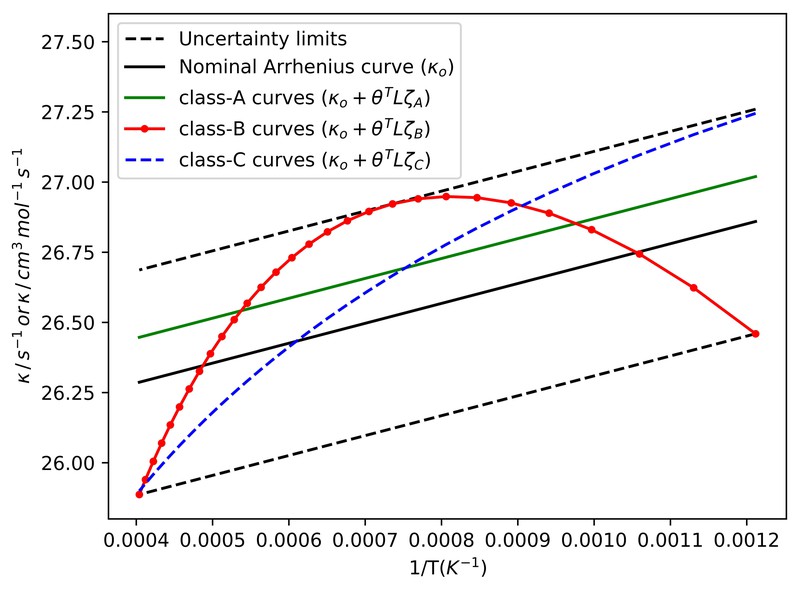
Chapter 4. Class-A, class-B and class-C Arrhenius curves between the uncertainty limits, reaction 2HO2 = H2O2 + O2 Explain Optimization
Chapter 4. Perturbing all Arrhenius parameters of reaction R1, with experimental data from the ReSpecTh database Explain Optimization
Chapter 4. Prior uncertainty vs temperature, reaction R4: this work (MUQ) compared with a literature result Explain Optimization
Chapter 4. Prior uncertainty vs temperature, reaction R5: this work (MUQ, MUQc) compared with literature results Explain Optimization
Chapter 4. Class-A Arrhenius curve samples with the uncertainty limits, reaction R9a Explain Optimization
Chapter 4. Class-B Arrhenius curve samples with the uncertainty limits, reaction R9a Explain Optimization
Chapter 4. Class-C Arrhenius curve samples with the uncertainty limits, reaction R9a Explain Optimization
Chapter 4. Relative errors for ignition-delay targets, search iterations and test data, PRS from a rank-7nc design matrix Explain Optimization
Chapter 4. Relative errors for flame-speed targets, search iterations and test data, PRS from a rank-7nc design matrix Explain Optimization
Chapter 4. Parity plot of PRS accuracy, training and testing data, ignition delay Explain Optimization
Chapter 4. Parity plot of PRS accuracy, training and testing data, flame speed Explain Optimization
Chapter 4. PRS tested on genetic-algorithm search iterations, ignition delay, parity line Explain Optimization
Chapter 4. PRS tested on genetic-algorithm search iterations, flame speed, parity line Explain Optimization
Chapter 4. Parity plot of PRS accuracy on search iterations, target Tig_1a Explain Optimization
Chapter 4. Parity plot of PRS accuracy on search iterations, target Fls_1c Explain Optimization