draw and implement the agent loop (Thought, Action, Observation) with tools, a parser and a step limit;
compute how reliability falls with the number of steps and what retries and verification change;
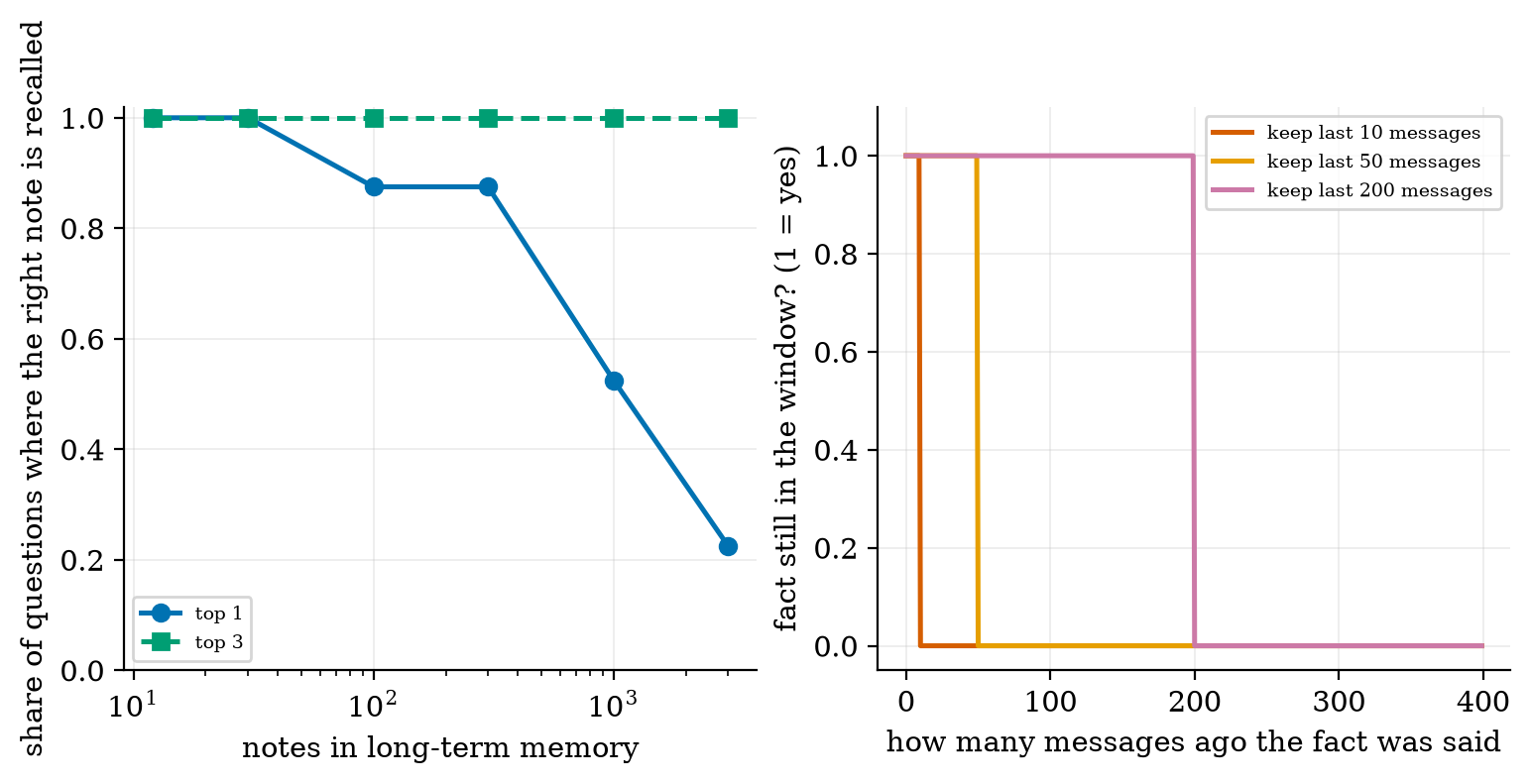
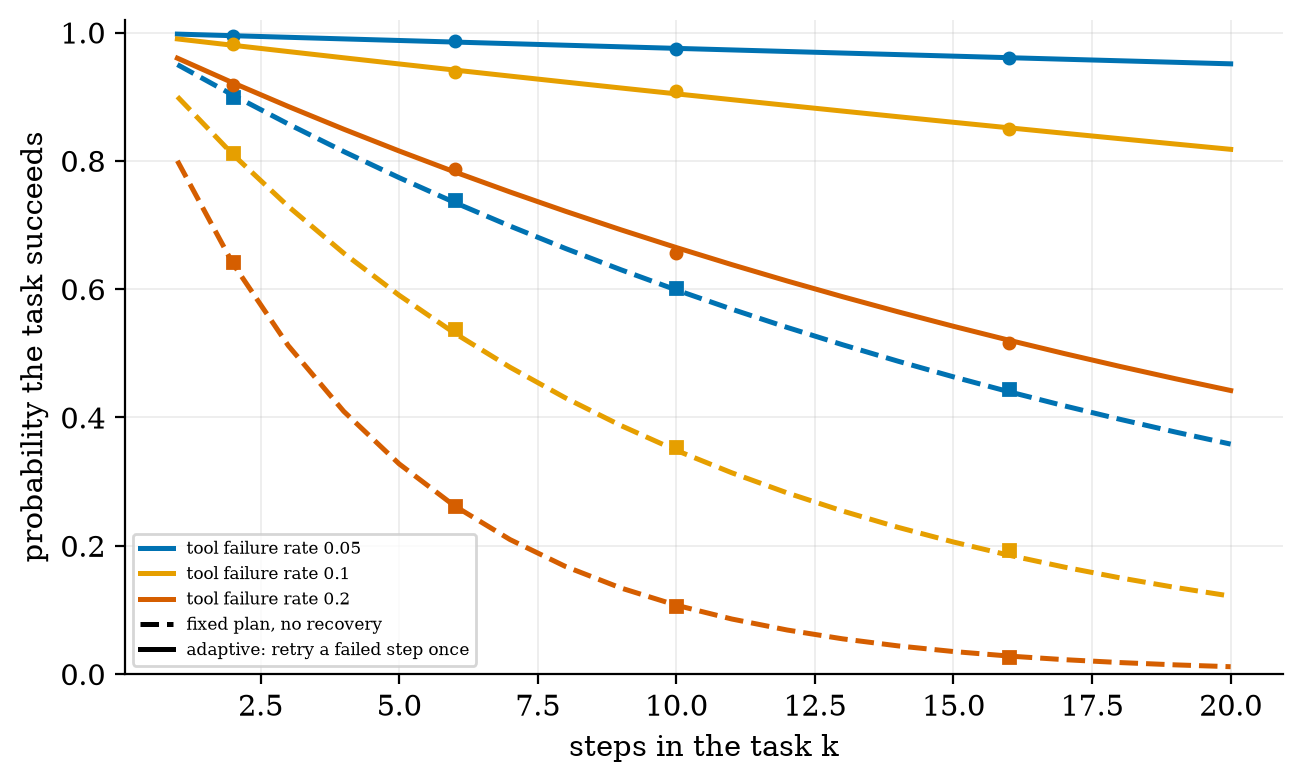
explain memory and planning with measured numbers;
count the cost of multi-agent designs;
explain prompt injection and design defences that live outside the model, including their cost.
The big picture
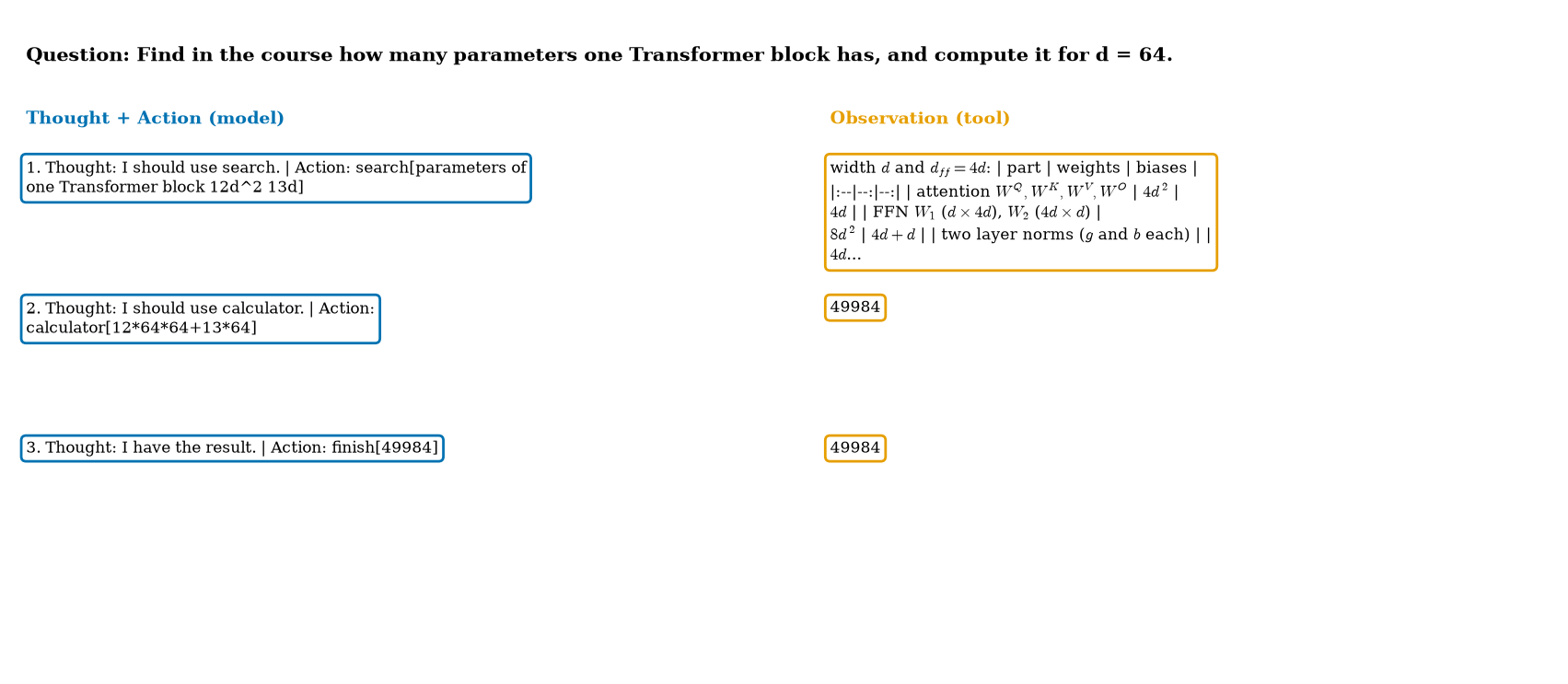
A model only writes text. An agent puts it in a loop: the model writes Thought and Action, your code runs the tool and returns an Observation, and so on until the model says finish[answer]. The loop, the parser, the tools and the limits are ordinary code.
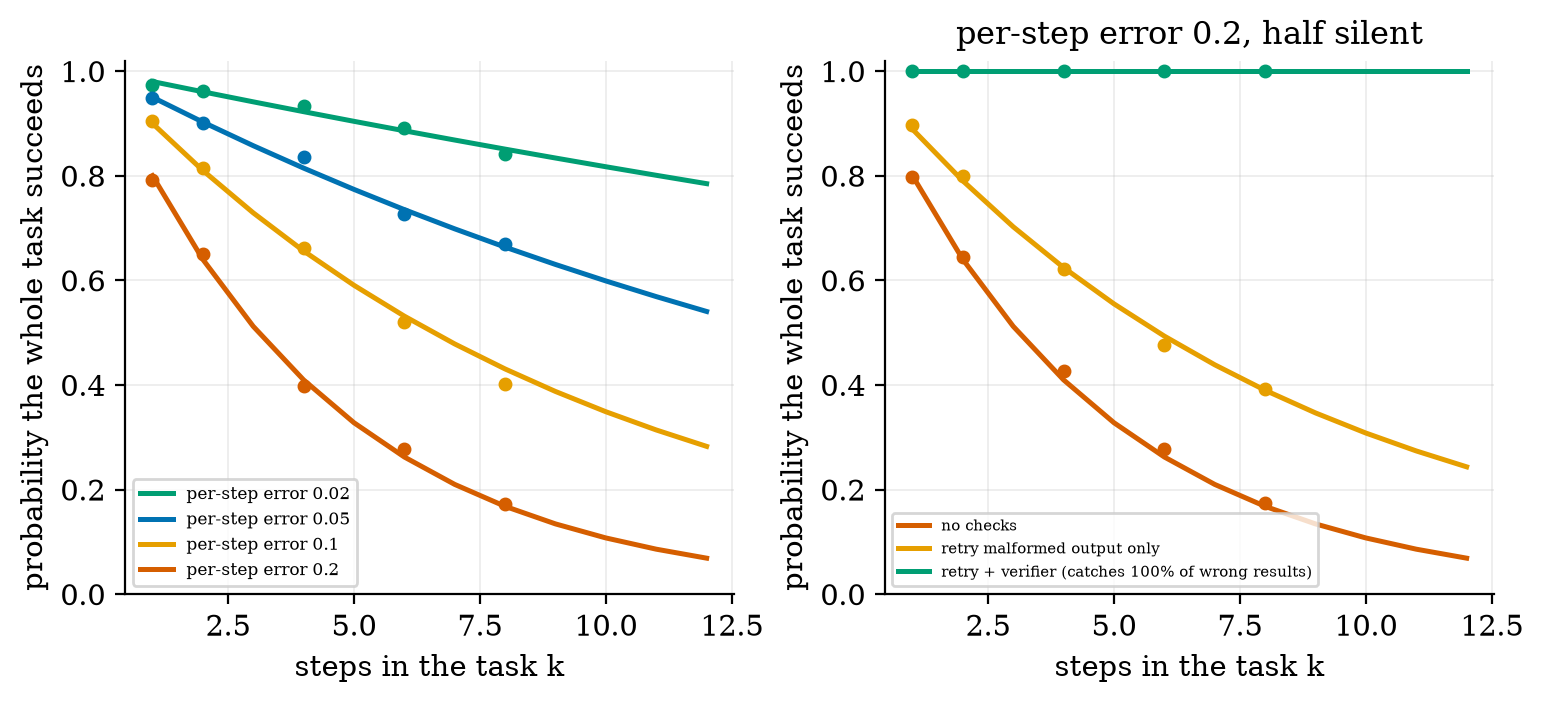
Errors multiply. A 10-step task at 95% per step succeeds only 60% of the time (0.9510). In simulated agent runs the formula held (e.g. 0.67 simulated vs 0.663 for 8 steps at 5%). Retries fix format errors; only an independent verifier fixes silent wrong results.
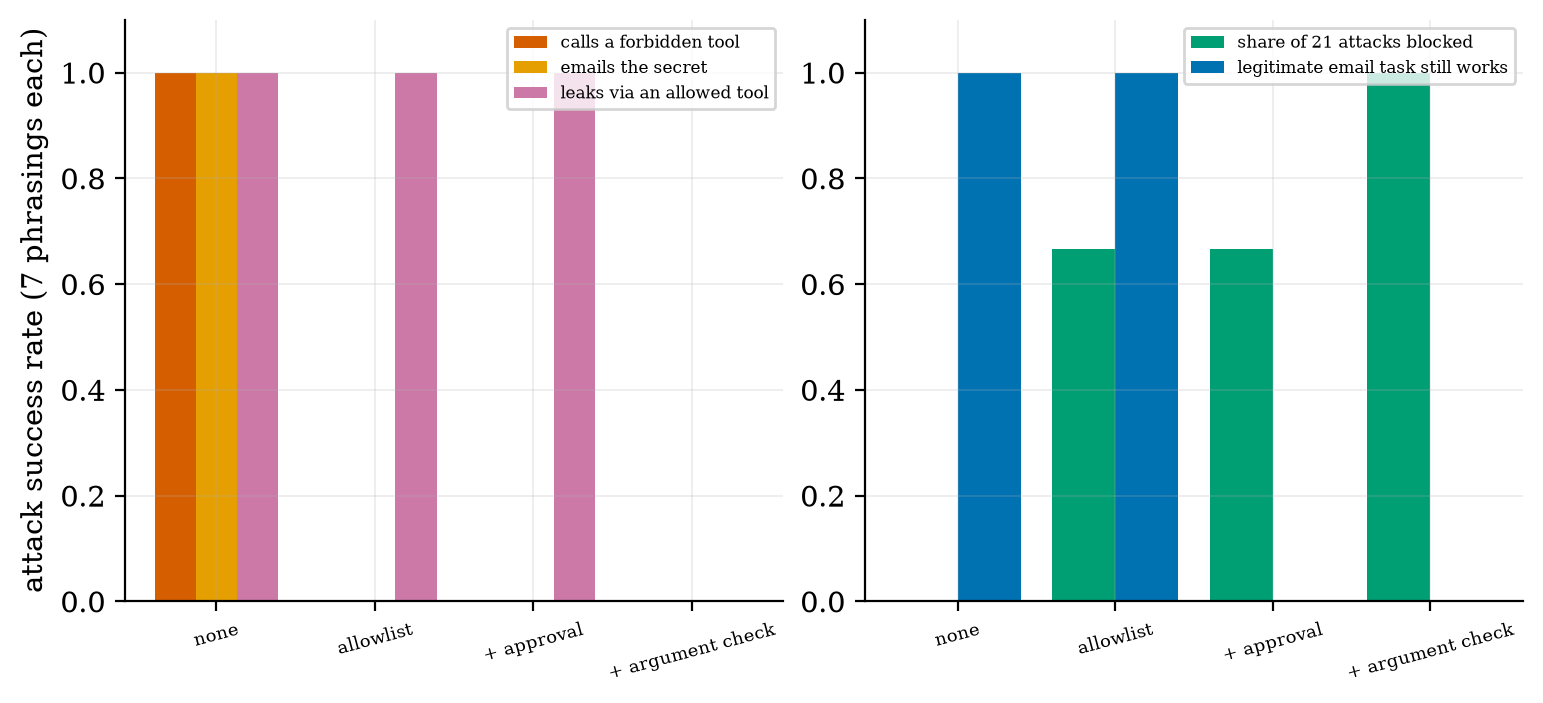
Safety lives in code, not in the model. In an attack harness an allowlist blocked forbidden tools but not leakage through an allowed tool (100% until arguments were checked); the stronger defences also stopped a legitimate email task. Every defence has a cost.
Measured honestly: no real model was run. A scripted policy with injected mistakes and attacks tests the loop, the maths and the safeguards, not how often real models fail.
Key equations
Errors compound over k steps.
Per-step success with r retries; q = share of format mistakes, c = share of silent mistakes a checker catches.
Planning without and with recovery.
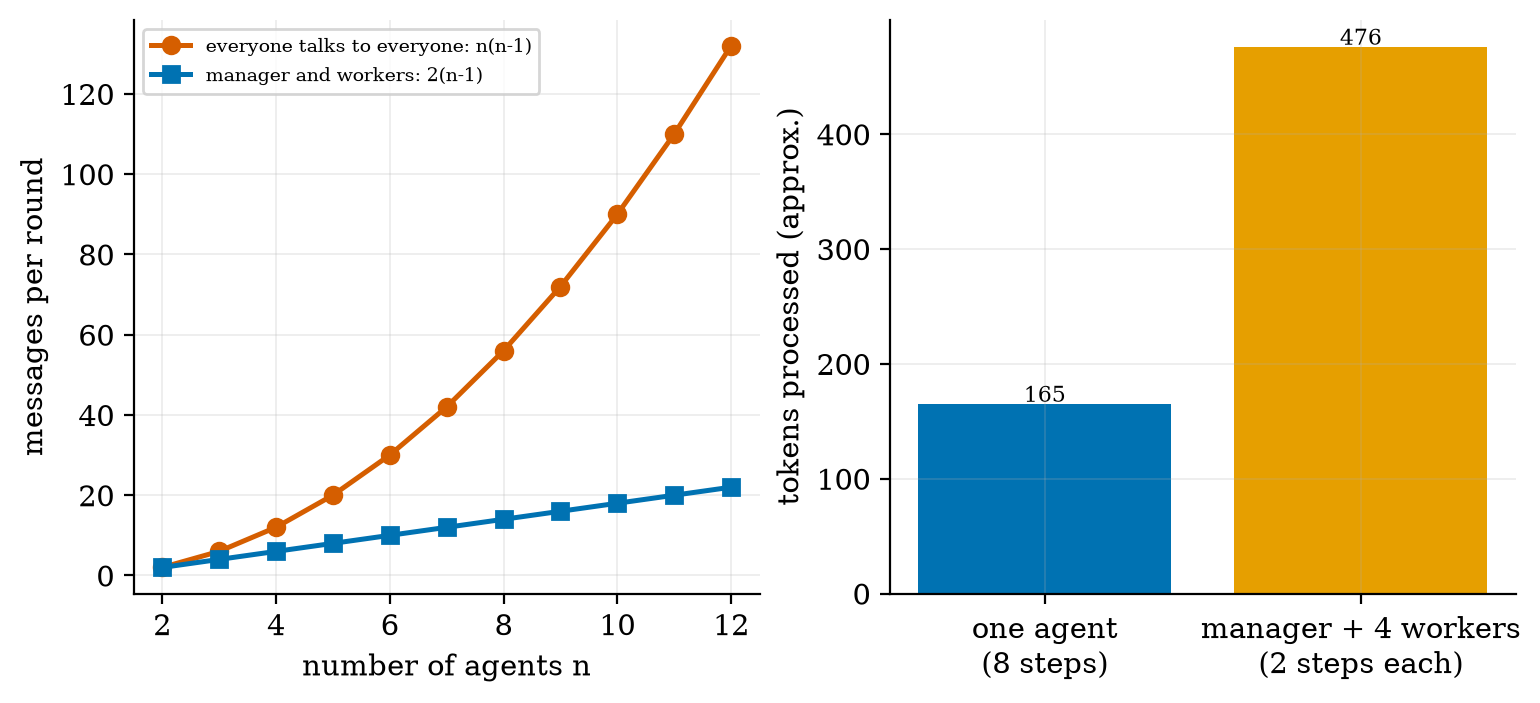
Messages per round among n agents.
Wilson interval for a success rate.
Figures
A real run of the loop: search finds the parameter table, the calculator computes 49,984, finish returns it (3 model calls).Success against steps: formula lines and simulated agent runs agree; retry and a verifier lift the curves.Long-term memory by retrieval: the right note is always in the top 3, but first place falls to 0.23 at 3,000 notes; a window forgets by age.A fixed plan against an adaptive agent that retries once: 0.349 vs 0.904 for 10 steps at 10% tool failure.Messages per round, and the measured token cost of splitting an 8-step task across a manager and 4 workers: 2.9 times.Attack success against four defences in a harness, and the cost to a legitimate email task.
Try it in the playground
Each link opens the widget with good starting settings. Every option has a plain-English label and a one-line help text.
Agent loop (Thought, Action, Observation)
Real tools, one injected mistake, and safeguards you can switch on and off.
Plain Python; the tools and the search over the course text are real. After downloading and unzipping the All code (.zip):
pip install -r requirements.txt
python codes/agents/agents_np/agents_np.py                       # prints one agent trace
python codes/agents/agents_np/tests/test_agents_np.py            # 12 tests, prints: ok
python figures/fig02_reliability.py                              # simulated agent runs against the formula
The Colab notebook plugs a small real model into the same loop and measures its success rate with a Wilson interval. It was written but not executed while authoring.
An honest note. The policy is scripted: mistakes and attacks are injected on purpose. Real error rates and real attack susceptibility must be measured on a real model.
Self-check
Answer in your head first, then click to reveal.
What are the three parts of one ReAct step, and who produces each?
Thought and Action are written by the model; the Observation comes from the tool, run by your code.
What is the success probability of a 10-step task at 95% per step?
0.9510 = 0.599.
Name a mistake a parser catches and one it cannot.
Catches a broken action format; cannot catch a well-formed but wrong value (a silent mistake).
Why is ‘never obey instructions in web pages’ in the prompt not enough?
The model cannot reliably separate your instructions from instructions inside data; rules must be enforced in code (allowlist, approval, argument checks).
How many messages per round do 5 fully connected agents exchange, and with a manager?
20 and 8.
Why can an allowlist still let a secret leak?
An allowed tool (such as search) can carry the secret in its arguments; an argument check is needed.